Design, etc
City Tickets is an exploration into how existing pieces of real-world urban infrastructure can be repurposed to better serve all of the citizens of the city in which they are installed.
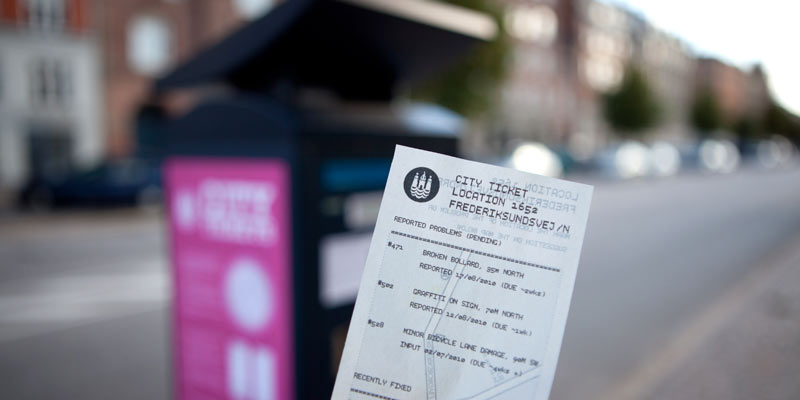
Pay-and-display multi-space parking terminals are examples of intensely technological infrastructure. City Tickets proposes to use them as a read/write entry point to a citizen responsiveness system such as 311, using the technology already found in such machines: a network connection, computation, and a thermal printer - and a basic street-facing interface.

Originally designed for the context of Copenhagen, a New York version was created for an exhibition at New York’s Museum of Modern Art in 2011, and a Boston version pushing live data to a repurposed parking terminal was exhibited at the Boston Society of Architects in 2013.


The concept explores how we can use these ubiquitous and expensive boxes to make cities more responsive to the needs of those who live in them, and proposes a service through which ticket machines become a communication channel between citizens and their local authorities. By taking functions that may otherwise be found on websites or interacted with through mobile devices or IVR phone systems, and physically embedding them directly in the urban fabric, City Tickets democratises access and input to municipal services and brings that dialogue to where it is most relevant and powerful: here and now.

In addition to the parking receipts that the machines currently dispense, terminals can print two additional types of ticket: a “city ticket to-do list” with a constantly updated summary of all the things the City knows are broken or have recently fixed in the very immediate vicinity of the machine in question, with a map-view of same; and a “city ticket report,” a form pre-filled with location details and space for a passerby to write in a 311 report, and a hyperlocal map for annotation or for marking the spot. The completed ticket can then be submitted free of charge at a mailbox, at any municipal office, or at participating retail locations. Although the contents of the report would need to be read and interpreted by a human, much as a phone call does, much of the metadata - location, date and time of the report - are machine readable, speeding up the process and bringing the issue one step closer to resolution.

Citizens are empowered to report problems - a pothole, a graffitied sign, or an awkward junction, for example - and to make suggestions for local improvements - benches for sitting on, or perhaps a weekly local market, or to have a say on local planning issues.

City Tickets make the bureaucratic and opaque workings of governance more transparent and accountable to the people it serves. Updating current machines to also issue city tickets in addition to existing parking tickets allows this existing infrastructure, without the necessity for any costly additional technology or a major upgrade, to be reconsidered as a way to make neighbourhoods more liveable and cities more responsive to the needs and desires of their inhabitants.
Urban infrastructure is often considered to be boring, technical, and purely functional - but the choices we make regarding which infrastructures to build, maintain, how we use them, and who we make them accessible to, are profoundly political and cultural.
Cities have the capability of providing something for everybody, only because, and only when, they are created by everybody”
- Jane Jacobs
Project description above.
City tickets started out as my thesis project at the Copenhagen Institute of Interaction design, in 2010. Below are some images of this original iteration of the project. More images, and higher resolution files, are available on Flickr.


Project description above.
A New York version of the project was created for an exhibition at New York’s Museum of Modern Art in 2011, situating the concept on the sidewalks of New York City. The City's existing naming of the multi-space terminals as "Muni Meters" suited the project perfectly, with city tickets taking the "municipal" part of the name to its logical conclusion. In addition, the City's existing NYC-311 service serves as the ideal technical backend for the proposed tickets.
More images, and higher resolution files, are available on Flickr.


Project description above.
A Boston version of the city tickets concept was created in 2013 for an exhibition at the Boston Society of Architects titled Reprogramming the City. Together with co-conspirators JD Hollis and Brian Del Vecchio, I repurposed an actual Boston pay-and-display multi space meter, on loan from the Department of Public Works, to produce tickets with live data from the City of Boston's Citizens Connect API. The terminals were renamed from Parking Meters to City Meters to highlight their broader potential use beyond the context of parking, to include bikeshare information, public transportation updates, local issue reports from a citizen responsiveness system, and public announcements.
More images, and higher resolution files, are available on Flickr.
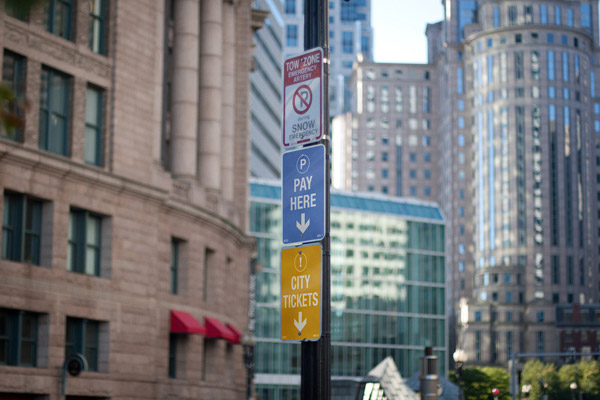


And finally, proof, of sorts, that it did in fact all work:

Comments or questions on the project are always welcome, as are proposals to discuss implementing the concept on the sidewalks of your city. Get in touch.
